There is a version of this story that is easy to tell and almost entirely wrong. It goes like this: a breeder in northern Canada has been producing Elkhounds for a long time, the dogs are good, and people who get them seem happy with them. That version is accurate as far as it goes. It does not go very far.
The real story is not comfortable, and it is not short. It is the story of a program that has consumed the better part of two decades — not as a hobby, not as a side interest, not as a commercial breeding enterprise dressed up in preservation language — but as a total commitment. Thousands of miles of remote terrain covered on foot, in all seasons, in conditions that most people are not equipped to enter. Thousands of hours in the evenings after those hikes, at a table covered in pedigree charts, lineage maps, genetic ancestry records, research papers on Scandinavian working dog history, correspondence with master breeders and old-time hunters who had walked these same mountains on the other side of the ocean. A program that required not just the will to do it, but the capacity to understand what you were doing — at the biological level, at the historical level, at the genetic level — well enough to make decisions that would not pay off for ten or fifteen years.
This article is about what that investment actually looks like. Not as a promotional story. As a statement of record — so that when people encounter the Kamia program and form quick, comfortable, uninformed opinions about it, they have the information available to understand what they are actually looking at.
The Research — What Happened After the Hikes
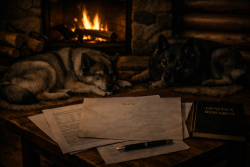 The public face of this program is dogs. People see the dogs, read about the dogs, and form their impressions around the dogs. What they do not see — what is almost entirely invisible unless you have lived it — is the research infrastructure that makes the dogs possible.
Every serious breeding decision in the Kamia program has been preceded by research. Not a quick online search. Not a glance at a pedigree and a gut feeling. Structured, multi-source, multi-generational research conducted over months and in some cases years before a breeding was confirmed. Lineage maps drawn by hand, revised as new information came in, and drawn again. Genetic genealogy records traced back through Scandinavian breed registries — Norwegian, Swedish, Finnish — to the point where the ancestry of a proposed pairing could be understood not just in terms of the dogs' registered names but in terms of the geographic regions, working traditions, and selective pressures that shaped their bloodlines generations before any of them crossed an ocean.
The long winter evenings in northern Canada are not a metaphor. They are the operational reality of a program located where this one is located — a place where the hiking season ends and the dark months begin, and where the hours that most people in more temperate climates spend on other things are available for the kind of sustained, uninterrupted research that this program requires. Correspondence with master breeders in Scandinavia. Translation of historical breeding records. Communication with old-time hunters — men and women who had worked Elkhounds and Jämthunds in the field for fifty years and whose knowledge of the original working dogs was not academic but lived. These relationships took time to build, and the knowledge they transmitted took time to absorb, verify, and apply.
"You cannot understand these dogs from a photograph. You cannot understand them from a breed standard. You cannot understand them from a kennel visit or a dog show. You understand them by spending decades in the terrain that shaped them — and then spending the winter going through everything written about them, in every language available, until the pattern becomes clear."
— Merv Carlson, Kamia KennelsThe genealogy work alone — the construction of detailed multi-generational pedigree maps that go far beyond what any registry database provides — represents a research investment that has no parallel in the registered Elkhound world. When you are building a program designed to function across decades, with breeding decisions made in year three whose consequences will not fully manifest until year eighteen, you need to understand the genetic architecture of your animals at a level of detail that the standard breed registry system was never designed to support. That detail had to be constructed, from primary sources, one lineage at a time.
This is not the description of a casual interest. It is the description of a discipline — applied consistently, over decades, without the validation of the mainstream breed community and without any guarantee that the results would arrive. They have arrived. But understanding what they cost requires understanding what the research commitment actually looked like.
Boots on the Ground — What Remote Terrain Actually Teaches
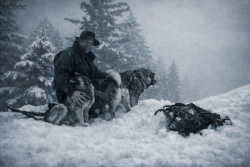 There is a category of knowledge about the Elkhound that cannot be acquired from books, registries, dog shows, or kennel visits. It can only be acquired in one place: remote terrain, far from civilization, with an Elkhound off lead. This is not a poetic statement. It is a precise description of the conditions under which the original selection pressure that built this breed operated — and the only conditions under which its behavioral architecture fully expresses and can be accurately evaluated.
The Kamia program has been accumulating this knowledge for decades. Not in managed trial settings. Not in controlled field test environments. In genuine backcountry — the kind of terrain where you are the only humans for miles in any direction, where the environmental pressure is real, where the dog's responses are not trained behaviors but instinctive ones, and where you quickly learn which dogs have the genuine functional architecture of the ancient Elkhound and which ones are carrying its appearance without its substance.
What this terrain teaches you about dogs cannot be communicated in a pedigree. A dog that appears structurally excellent on the show table may be completely unable to manage a fifteen-kilometre mountain traverse over broken ground in adverse weather. A dog that wins working trials in a controlled setting may completely shut down when the terrain gets genuinely remote and the handler is no longer the most dominant presence in the environment. The dogs that perform in genuine remote terrain — day after day, season after season, across multiple years — carry something in their architecture that is identifiable, consistent, and heritable. And knowing which dogs carry it requires having been in that terrain long enough, and with enough dogs over enough years, to recognize the pattern when it appears.
What you learn about a dog's true architecture only in genuine backcountry conditions
- Whether the dog's independence is functional or anxiety-driven — the terrain makes this distinction unmistakable
- Whether scenting ability is genuine and sustained over distance, or a trained-environment artifact
- Whether structural soundness holds across varied footing, elevation change, and extended physical demand
- Whether environmental confidence is stable under genuine pressure — unfamiliar terrain, wildlife sign, exposure
- Whether handler communication is a working partnership or a dependency — genuine ancient Elkhound behavior requires both independence and orientation
- Whether the dog self-regulates its energy expenditure intelligently across a long day — a critical longevity indicator
- Whether the behavioral architecture that was bred into the dog matches the physical architecture — they must be congruent
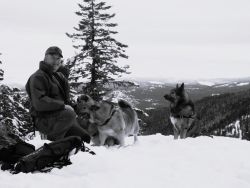 The thousands of miles logged in remote terrain over the course of this program are not a training statistic. They are the primary data collection methodology. Every mile walked with an Elkhound off lead in genuine backcountry adds to an observational database that cannot be replicated in any other setting — and that informs breeding decisions in ways that no health test, conformation score, or trial result can approach.
This is the part of the program that is entirely invisible to the outside observer. Nobody posts photographs from a fifteen-kilometre traverse in rain and fog at four hundred metres of elevation. Nobody writes field reports about the dog that turned back half a mile before you reached the ridgeline and the one that covered every metre of the descent without hesitation and then settled immediately at camp without residual anxiety. But this is where the actual work happens. This is where the dogs are evaluated against the standard that actually matters — the standard the northern terrain itself applies.
On the Critics — What They Actually Know
Every serious program in a field dominated by convention will attract a category of critic whose confidence in their opinion is inversely proportional to their relevant knowledge. The Kamia program is not an exception. Over the decades, there have been voices in the Elkhound community — some attached to kennel clubs, some operating their own breeding programs, some simply participants in the online breed conversation — who have characterized this program with varying degrees of dismissal. Just a cross program. Not real preservation. Not what they claim it is.
These characterizations are not worth arguing with at length. But they are worth examining briefly, because understanding what they reveal about the speaker is useful context for anyone trying to evaluate the program from outside it.
The critics of programs like Kamia's share a set of common characteristics that are worth naming: no demonstrated knowledge of the genetic history of the Scandinavian working dog populations from which the modern breeds descend; no documented experience in genuine remote terrain with Elkhounds working off lead in conditions that approach anything resembling original working pressure; no working relationship with the master breeders, old-time hunters, or Scandinavian breed historians whose knowledge is the primary source base for any serious historical restoration program; and no multi-generational breeding program of their own whose results can be evaluated against the functional criteria they claim to be defending. They are defending a convention — the registered-breed system and its attendant authority structures — not a dog.
The "cross program" characterization deserves a direct answer, because it is the one most frequently deployed and the one that most clearly reveals the speaker's genetic illiteracy. A cross program is a program that combines distinct, unrelated breeds to produce a hybrid type. What the Kamia program does is the opposite: it works with the pre-registry genetic population from which the modern Norwegian Elkhound, the Jämthund, and the Finnish hunting dogs all descend — a population that was never separated into distinct breeds by biology, only by administrative decision. Returning to that shared ancestral gene pool, using carefully researched and historically authenticated lines, is not crossing. It is the only meaningful definition of restoration.
The registered Norwegian Elkhound and the Jämthund are not distinct species that arose through separate evolutionary processes. They are administrative constructs — subpopulations of a shared northern landrace that were pulled apart by kennel club decisions in the late nineteenth century and then sealed off from each other by closed studbooks. The original dogs of the north were not separated this way. The people who bred them, hunted with them, and depended on them did not recognize those administrative boundaries, because those boundaries did not exist yet. Working back toward the genetic reality that preceded those boundaries is not a cross. It is the entire point.
The Kamia program does not need the approval of people who have never walked in remote terrain with an Elkhound, who have never studied the pre-registry genetic history of the northern working dog populations, and who have never built and maintained a multi-generational working program of their own. The program has been running for decades without that approval and will continue to run without it. The dogs are the answer to every critique that has ever been levelled — and the dogs are getting better with every generation.
"We are not trying to please the crowd. We never were. The crowd has been selecting the wrong things in these dogs for a hundred and fifty years, and the gene pool shows it. Pleasing the crowd is what produced the problem. We are trying to produce the ancient Elkhound — and that requires being willing to be misunderstood by everyone who has a stake in the current system."
— Merv Carlson, Kamia KennelsThe Network — What Makes the Impossible Possible
No program of this depth and duration is built by one person. The Kamia program is built by a network — and understanding what that network actually consists of, and what it contributes, is essential to understanding why the results are what they are.
The network has several distinct layers, and each is indispensable.
The Old Timers and Master Breeders
The most irreplaceable knowledge in any traditional working breed program is the knowledge held by the people who worked the original dogs — who hunted with them, bred them without reference to kennel clubs, and understood their behavior and capacity at a level that no academic study of the modern breed can provide. This knowledge is not written down in any registry database. It lives in the memories and observational records of a small and aging population of breeders and hunters in Scandinavia and northern North America whose working relationship with these dogs predates the modern breed system or exists at its margins.
The Kamia program has spent decades cultivating relationships with this population. These are not casual email contacts. They are sustained working relationships — built over years, maintained through genuine reciprocal exchange, and productive of knowledge that has directly shaped every major breeding decision in the program's history. When an old Finnish bear-hunter describes the behavioral characteristics of the dogs he worked with fifty years ago in the Karelian forests, and those descriptions match precisely what is now appearing in six-week-old Kamia puppies, something real is being confirmed.
The Co-Breeders
The co-breeder relationships in the Kamia program are not administrative arrangements. They are working partnerships — with breeders whose own lineage knowledge, terrain access, and commitment to the same functional standard brings something to the program that could not be sourced any other way. Without the co-breeder network, the genetic diversity required to maintain a genuine restoration program — one that is not simply recycling a narrow registry population under a different name — would be impossible to sustain.
Co-breeding is one of the most demanding relationship types in working dog programs. It requires a shared standard that is more than a written document — it requires a shared understanding of what the standard means in practice, in the field, over multiple generations. Building that shared understanding takes time, communication, and mutual trust that can only be developed through demonstrated commitment to the same goals. The Kamia co-breeder relationships represent some of the most important partnerships in the entire program architecture.
The Stewards
Every dog placed from the Kamia program goes to a steward — a family or individual who understands, from the beginning, that they are participating in something larger than pet ownership. The stewardship relationship is the program's interface with the real world: it is where the dogs are actually evaluated against living conditions, where their behavioral architecture either expresses or does not, and where the feedback that informs the next generation of breeding decisions originates.
The feedback that comes back from stewards working dogs in genuine conditions — Reidar on a New Hampshire mountain trail detecting a human presence around a corner before the human is visible; Sola at sixteen weeks reading a bear intrusion and responding with calibrated territorial confidence; Nyra and Aurella running a self-regulating two-dog bear patrol without direction — this is the most important data the program generates. It is real-world validation from real working conditions, provided by families who trust the program enough to invest in it and who take seriously enough to report back honestly on what they observe.
Four layers of human investment — each indispensable, none replaceable
- Old-time hunters & master breeders: Living repositories of pre-registry working knowledge from Scandinavia and northern North America — irreplaceable primary sources
- Scandinavian breed historians & researchers: Academic and archival knowledge of the pre-registry dog populations, genetic history, and regional working traditions
- Co-breeders: Working partners whose lineage access, terrain knowledge, and shared commitment to functional standards make the genetic architecture of the program possible
- Stewards: Families working the dogs in real conditions, providing real-world behavioral validation and the feedback that drives generational improvement
The Results — Decades of Norrland, Norwegian, and Jämthund Success. And Now the Full Bloods.
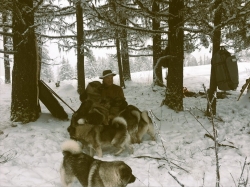 The Kamia program did not begin with the Full Blood Norwegian Elkhound. It began with the Norrland dogs — the foundational northern working line that pre-dates and underlies all of what came after. Those dogs produced results that the people who worked with them have talked about for decades, in terrain and working conditions that most registered-breed dogs could not approach. The Norrland results are not a claim. They are a documented, multigenerational record that the people who have been part of this program for a long time do not need to argue about.
The Norwegian Elkhound and Jämthund lines followed, each carrying the specific working architecture of their regional heritage into the program's broader genetic framework. The results in both cases were the same: dogs that functioned at a level that the mainstream registered populations could not match, in terrain and conditions that the mainstream program had never been designed to address. These results are widely known among the people who matter — the hunters, the working-dog families, the remote-terrain hikers who have put these dogs through real tests over real years. The dogs speak for themselves.
But the Full Blood Norwegian Elkhound restoration — the newest and most complex stream of the program — is something different in character, even within the Kamia framework. It is the program's most ambitious undertaking: a genuine, multi-source, open-genetic restoration of the pre-registry northern dog in its Norwegian expression, built from the ground up over multiple generations with a level of research depth and genetic intentionality that has no equivalent anywhere else in the world.
And now, in 2026, it is producing dogs. Real dogs. Working dogs. Dogs that demonstrate, in the field, in remote terrain, in genuine working conditions, the behavioral architecture that existed in the northern forests before the kennel clubs arrived and began the process of selective reduction that cost the breed most of what made it remarkable. Sola, baying at bears at sixteen weeks. Nyra and Aurella running a self-directed bear management protocol. Sig and Kaia in synchronized working partnership. Reidar detecting a human presence around a mountain corner before the human is visible. Torin — from the first Full Blood litter — now ready to enter the breeding program and carry this architecture forward into the next generation.
"To see the Full Bloods producing the way they are producing — after everything that went into designing this program, after all the research and the miles and the relationships and the patience — it's hard to find the right word for it. Confirmation is accurate. Vindication is accurate. But what it really feels like is simply: this is what was always supposed to happen. We built it so that it would."
— Merv Carlson, Kamia Kennels, July 2026What No Other Program in the World Has Done
The claim that this program is unique is not a marketing statement. It is a verifiable structural observation. There is no other program anywhere on the planet that combines all of the following elements simultaneously:
A research foundation built from multi-decade engagement with primary Scandinavian sources — master breeders, old-time hunters, breed historians, pre-registry genealogical records. A genetic architecture that draws on authenticated pre-registry lineages from multiple northern Scandinavian working traditions rather than working within the closed gene pool of any single modern registry. A multi-generational breeding plan with decade-scale decision horizons — where the breeding decisions being made today are designed around outcomes that will be evaluated in 2035 and 2040. An active stewardship network providing real-world behavioral validation from genuine working conditions across multiple geographies. And a co-breeder network whose own lineage access and commitment to functional standards extends the program's genetic reach beyond what any single program could achieve independently.
This combination does not exist anywhere else. It is not close to existing anywhere else. The closest analog programs — the serious working-line preservation efforts for other northern breeds in Scandinavia itself — do not combine open genetic sourcing with the research depth, the terrain evaluation methodology, the stewardship architecture, and the multi-decade planning horizon that characterize this program.
That is not said to diminish those efforts, which are serious and valuable in their own right. It is said to provide honest context for anyone attempting to evaluate the Kamia program against some imagined field of equivalents. The field of equivalents does not exist. This program is, structurally and operationally, in a category by itself.
Building a program of this structure requires a specific and rare combination: deep genetic and historical research capacity; sustained access to remote working terrain; the patience to operate on multi-decade planning horizons without the validation of the mainstream breed community; the relationship capital to build and maintain co-breeder and stewardship networks of genuine quality; and the willingness to be misunderstood, dismissed, and criticized by people whose opinion of the program is formed without the knowledge required to evaluate it. These requirements do not coexist easily. In the global working-dog breeding community, they appear to have coexisted, for decades, in one place.
What This Means Going Forward
 The results appearing in 2026 are not the culmination of the program. They are confirmation that the foundation is solid enough to build on — that the genetic architecture is working as designed, that the stewardship network is producing the observational feedback the program needs, and that the decisions made in the research sessions of the 1990s and 2000s and 2010s were the right decisions.
The program continues. More Full Blood litters are planned. Torin enters the breeding program carrying the genetics of the first generation into the second. The stewardship network grows as more families in more geographies take on Full Blood dogs and begin returning the field feedback that the next generation of breeding decisions will be built on. The co-breeder relationships deepen as the results give everyone in the network confidence that the architecture is delivering on its promise.
For the people inside the program — the families who have trusted it with their time, their terrain, and their homes — none of this requires explanation. They are living it. They see it in their dogs every day. For the people outside the program who have formed quick opinions on the basis of minimal information, this article offers the information that those opinions were missing. For the critics — the ones whose dismissals have been made without knowledge of the lineage history, without experience in remote terrain with an Elkhound, and without any working program of their own whose results can be evaluated — the dogs themselves are the only response that matters.
They are working. They have always been working. And they are getting better.